

👋 Hey, it’s Munmun. Welcome to my newsletter on data and behavioral science for growth.
Read time: 5 minutes
Last week I was holidaying in Bali, and my hotel was on a street with many money exchangers. After exchanging cash at one of them, I walked into a clothing store right on the opposite side of the road. The saleswoman saw me coming from the exchanger and asked me twice if I had counted my money properly. That prompted me to check again, and I realized the amount was less than what I had counted earlier at the exchanger.
So I went back to the exchanger and asked him to do a new transaction. This time I watched him closely. After I had counted the exchanged currency notes, he smoothly touched the stack again and, through a sleight of hand, removed a few notes. That’s when I asked him if I could recount, and he realized he'd been caught, so he refused to proceed with the exchange.
Well, a useful lesson learned for future trips involving currency exchange.
The gentle nudge of the saleswoman was also a nice reminder for me of the power of nudges. Nudges are different from Call to Actions. They are not meant to persuade you to take any action. They are gentle interventions that:
Appear just before a mistake happens
Are simple, not overwhelming
Give control back to the user
Most of us are getting nudged these days by ChatGPT follow-up suggestions that appear right after an answer, keeping the interaction going without you having to think about what’s next.
Another favorite of mine is Gmail's follow-up prompts, which have helped me avoid losing track of ongoing conversations.
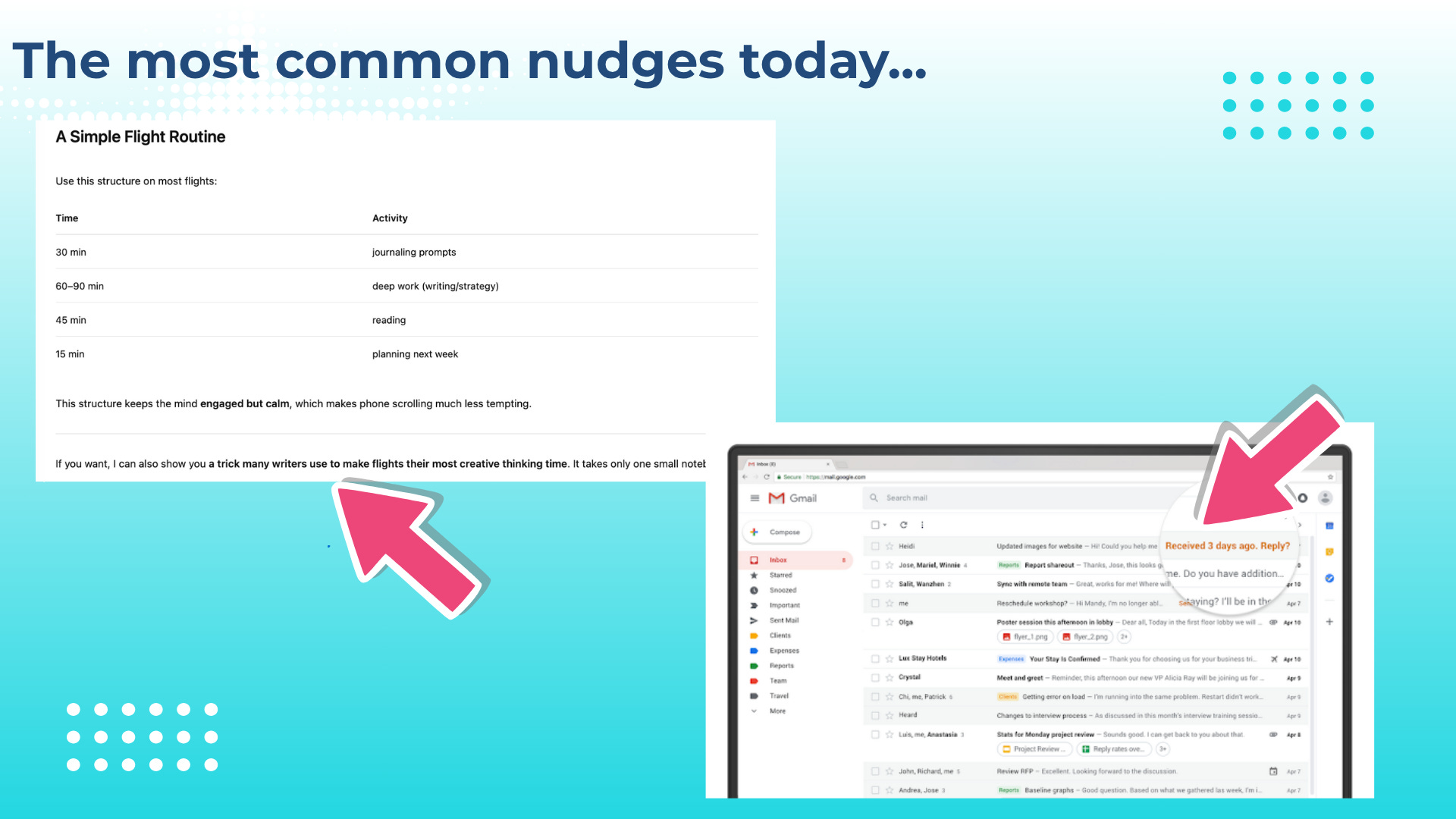
The classic book by Sunstein and Thaler’s ‘Nudge’ that popularised the idea, uses the example of changing the layout of food in a cafeteria in order to encourage healthier eating - fruit at eye level, chocolates a little harder to get to.
Nudges are avoidable - the user still has a choice, but the nudge aims to help them to make a ‘better’ decision.
“To count as a mere nudge, the intervention must be easy and cheap to avoid. Nudges are not mandates. Putting fruit at eye level counts as a nudge. Banning junk food does not”.
If you are interested in more examples, this file has more than 100 classic nudges.
For growth teams, the most effective way to implement a nudge would be to go beyond static, one-size-fits-all approaches. You can group users by real-time behavior, location, goals, and demographics (age, income, or broad spending patterns) to create dynamic, personalized nudges.
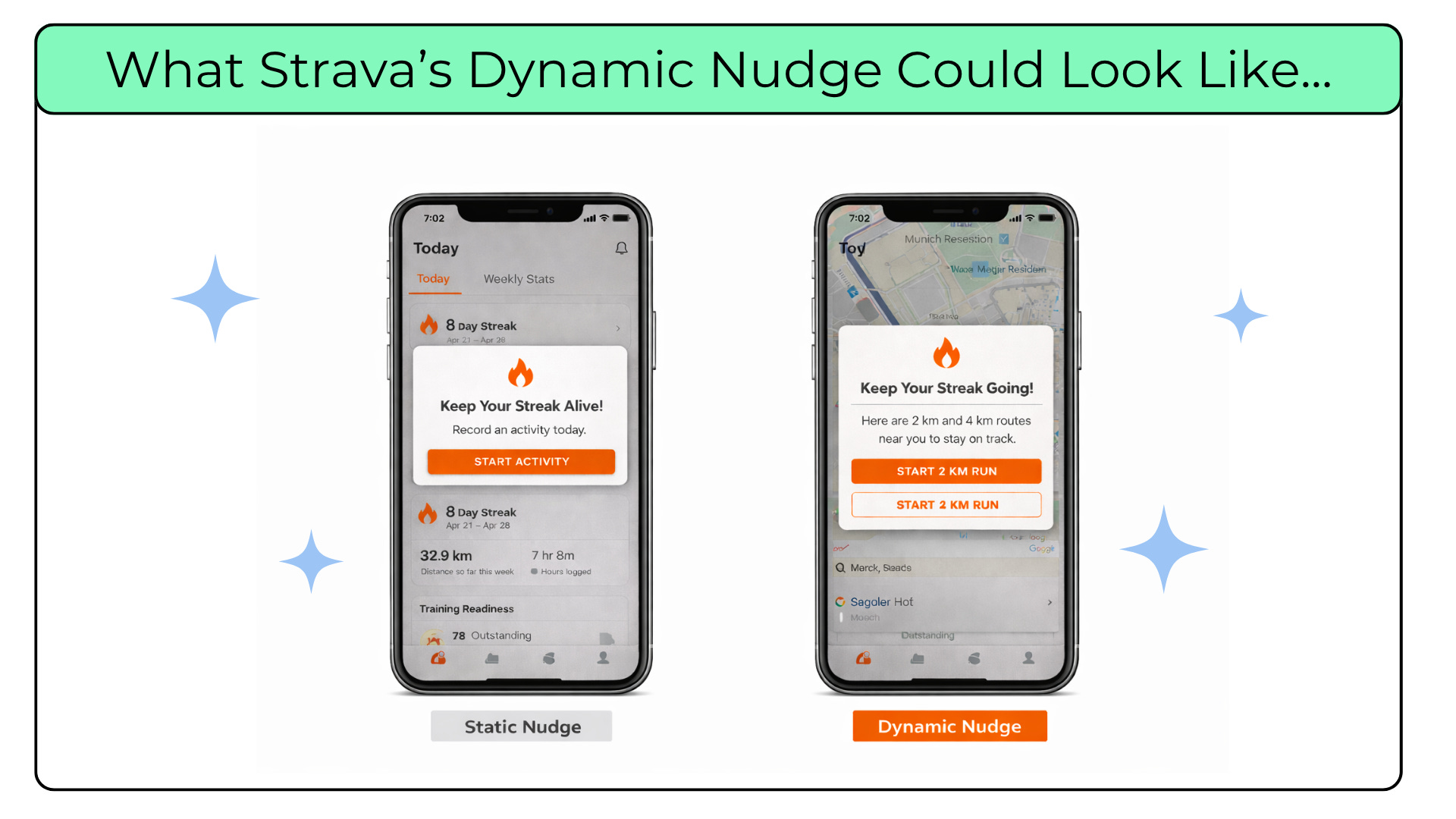
For example, fitness tracking app Strava nudges you to work out to maintain a streak like this:
“Keep your streak alive. Record an activity today.”
This is static for all users. A dynamic nudge could be based on a location change detection, and predicting a travel-related streak disruption, leading Strava to nudge:
“New city today. Here’s a 2 km route near you to keep your streak alive.”
As Dalecke, S. & Karlsen, R. (2020) in their paper Designing Dynamic and Personalized Nudges point out: